Moral Alignment Chart: All 9 Alignments Explained
A complete 3x3 alignment chart guide covering Lawful Good through Chaotic Evil—with comparison tables, ethical parallels, and borderline reading tips.
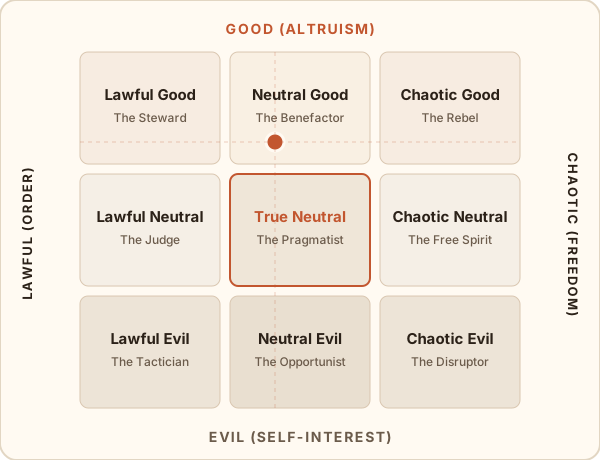
How to Read the 3x3 Moral Alignment Chart
The Moral Alignment Chart is a 3×3 coordinate grid formed by crossing two independent ethical axes: Order (running horizontally from Lawful to Neutral to Chaotic) and Morality (running vertically from Good to Neutral to Evil). First formalized in tabletop role-playing rules—as outlined in the D&D Basic Rules on Alignment and documented in Alignment (Dungeons & Dragons) history—the chart became a universal shorthand for comparing ethical instincts, fictional characters, and real-world dilemmas.
Not sure where you fall on the grid? Take our free 24-question Moral Alignment Test to plot your exact XY coordinates, or try our tabletop-focused D&D Alignment Test to map a campaign character.
Quick Comparison Table: All 9 Moral Alignments
| Alignment | Code | Archetype | Order Stance | Morality Stance | Closest Ethical Philosophy |
|---|---|---|---|---|---|
| Lawful Good | LG | The Steward | High trust in fair rules & oaths | High altruism & care | Duty-based ethics (Deontology) |
| Neutral Good | NG | The Benefactor | Pragmatic about rules | High altruism & kindness | Care ethics & benevolent consequentialism |
| Chaotic Good | CG | The Rebel | Distrusts rigid authority | High altruism & freedom | Conscience-driven liberation ethics |
| Lawful Neutral | LN | The Judge | Strict loyalty to codes & order | Impartial / balanced | Rule formalism & contractualism |
| True Neutral | TN | The Pragmatist | Context-dependent | Context-dependent | Situational pragmatism & equilibrium |
| Chaotic Neutral | CN | The Free Spirit | Strong personal autonomy | Self-directed, non-malicious | Radical individualism |
| Lawful Evil | LE | The Tactician | Exploits systems & hierarchy | Strategic self-interest | Authoritarian instrumentalism |
| Neutral Evil | NE | The Opportunist | Ignores or uses rules at will | Pragmatic self-advantage | Psychological egoism |
| Chaotic Evil | CE | The Disruptor | Rejects all external constraints | Unchecked impulse & power | Antinomian self-assertion |

Deep Dive: All Nine Positions on the Alignment Chart
1. Lawful Good (LG — The Steward)
Lawful Good pairs active altruism with respect for dependable systems, promises, and fairness. A Lawful Good person believes that shared rules exist to protect vulnerable people from arbitrary power.
- Core strengths: Dependable follow-through, principled advocacy, calm stewardship during crises.
- Potential blind spot: Hesitating to break an outdated rule even when rapid improvisation would help someone sooner.
2. Neutral Good (NG — The Benefactor)
Neutral Good focuses directly on helping others without being rigidly tied to either hierarchy or rebellion. If an institution works well, Neutral Good cooperates smoothly; if red tape harms people, Neutral Good quietly finds a humane workaround.
- Core strengths: Empathy, practical problem-solving, bridge-building across factions.
- Potential blind spot: Spreading energy too thin by trying to keep everyone supported without clear boundaries.
3. Chaotic Good (CG — The Rebel)
Chaotic Good prioritizes personal conscience and individual liberty over formal authority. When rules feel unjust or performative, Chaotic Good trusts direct action to stand up for the underdog.
- Core strengths: Moral courage, creativity, fierce protection of autonomy and fairness.
- Potential blind spot: Rejecting helpful coordination or stable agreements simply because they feel restrictive.
4. Lawful Neutral (LN — The Judge)
Lawful Neutral anchors on predictability, impartial codes, and kept obligations—closely paralleling the conventional law-and-order reasoning examined in Kohlberg's moral development framework.
- Core strengths: Consistency, objectivity, reliability under high stakes.
- Potential blind spot: Treating the letter of a policy as more important than the human cost of enforcing it.
5. True Neutral (TN — The Pragmatist)
True Neutral sits at the center of the alignment chart, avoiding rigid ideology in favor of proportionality and context. True Neutral decision-makers ask what actually fits the moment rather than defaulting to loyalty or defiance.
- Core strengths: Balanced judgment, adaptability, resistance to polarization.
- Potential blind spot: Appearing indecisive when a group needs a clear moral stance.
6. Chaotic Neutral (CN — The Free Spirit)
Chaotic Neutral treasures independence, spontaneity, and living on one's own terms without preaching to others. Rather than aiming to harm or rescue anyone, Chaotic Neutral resists unnecessary control.
- Core strengths: Originality, resilience in uncertain settings, freedom from peer pressure.
- Potential blind spot: Struggling with long-term commitments or shared schedules that require predictable teamwork.
7. Lawful Evil (LE — The Tactician)
In alignment-chart terminology, "Evil" represents strategic self-interest rather than cartoon villainy. Lawful Evil understands rules, contracts, and hierarchies deeply and uses order to secure personal advantage.
- Core strengths (in fiction & strategy): Long-horizon planning, discipline, mastery of incentives.
- Core tension: Treating fairness as a game of loopholes rather than genuine concern for others.
8. Neutral Evil (NE — The Opportunist)
Neutral Evil represents pure pragmatic self-focus without ideological attachment to either order or chaos. Rules are followed when convenient and bypassed the instant they create friction.
- Core tension: Eroding long-term trust because alliances are always conditional on immediate payoff.
9. Chaotic Evil (CE — The Disruptor)
Chaotic Evil sits at the intersection of unchecked impulse and defiance of social constraints. In tabletop campaigns and stories, it characterizes forces of pure disruption; in real-life self-reflection, landing near this corner usually reflects intense frustration with rules and skepticism toward altruism.
Understanding Borderline Coordinates
Real ethical decision-making rarely sits dead-center inside one square. Because moral development research and Moral Foundations Theory show that people weigh multiple values at once, most test-takers fall near the boundary between two neighboring alignments—such as Neutral Good bordering Lawful Good.
When you take our Moral Alignment Test, pay attention to both your primary quadrant and your closest neighboring alignment calculated from your exact XY crosshair. Want to see how these nine archetypes play out in fantasy campaigns? Head over to our D&D Alignment Test or learn how our scoring works on the About & Methodology page.